Here, children's creativity serves as an educational model
Published: December 19, 2024
Operations, Miscellaneous
Santa has lost his hat, and now it’s up to the children to find a new one. In the magical store, they find a hat that fits, and the store accepts movement as payment. This is the plot of Emma-Helena Berglund’s latest dramatic adventure, which she created together with the children at the Tellus Group’s cultural preschools.
“Children learn best through play and interaction. Here, they come together in group activities such as music and drama, where they can be creative and express themselves. At the same time, they develop important social skills,” says Emma-Helena Berglund, cultural educator at Tellusgruppen.
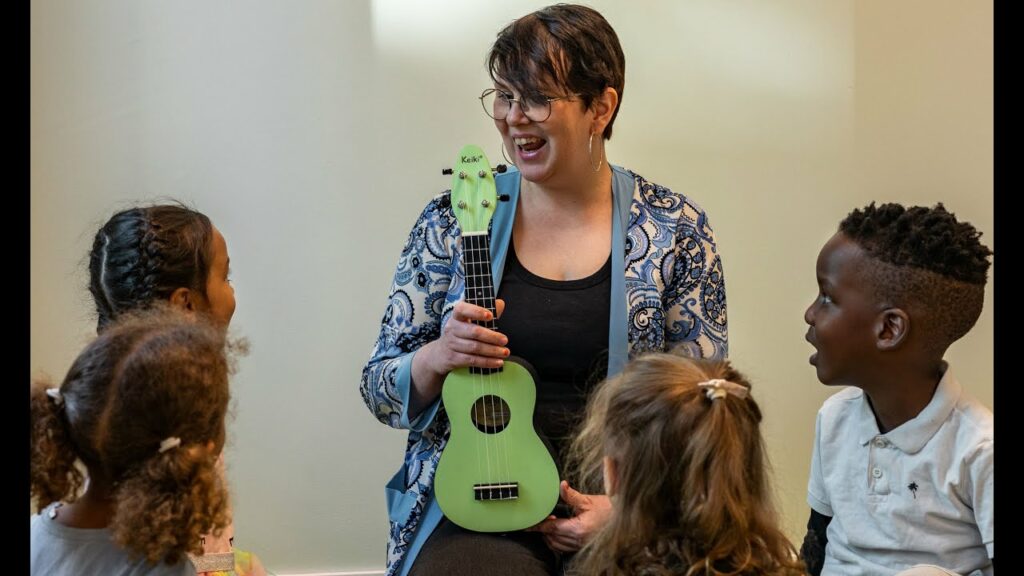
Emma-Helena Berglund, cultural educator at Tellusgruppen.
At the Tellus Group’s cultural preschools, culture is not just an element, but a cornerstone of the educational approach. There, culture is a natural part of everyday life, and through music, drama, art, and dance, a unique learning environment is created where the children’s development—both individually and as a group—takes center stage. Art, drama, and music educators collaborate to provide an inspiring environment. For example, children can learn to play the violin or percussion instruments and take part in drama adventures.
“The children are always involved. They don’t just watch—they contribute themselves. And it’s through that involvement that their creativity and self-confidence are strengthened,” says Emma-Helena.
The Importance of Culture for Children's Development
Emma-Helena leads drama adventures where the children get to collaborate, explore, and express themselves in different ways. The activities are often based on themes such as “being a good friend” and “stop my body,” which are rooted in the preschool’s core values.
“Through dramatic play, children can explore their feelings and understand others’ perspectives. It’s a playful way to work on important values like respect and empathy,” says Emma-Helena.
In addition to the cultural preschools, Emma-Helena also works on developing workshops for educators, including at the Tellus Group’s key preschools, where the focus is on language-developing games and songs.
– From a linguistic perspective, culture and drama as educational approaches are very enriching, especially for children who do not speak Swedish as their first language. It’s also about body language and facial expressions—basically, all aspects of communication.
Development That Prepares for Life
A safe and inspiring environment is essential for children to be able to express themselves and feel confident enough to explore. Through play—both free and organized—interactions among the children are encouraged.
“We create an environment where children feel safe and can let their creativity run free. It’s about learning to interact with others and growing as individuals within the group,” says Emma-Helena.
The Tellus Group’s cultural preschools are places where children can develop their creativity and collaborative skills through music, drama, and art. The goal is for these experiences to prepare them not only for school, but also for life.
“Using culture as a pedagogical tool gives children the opportunity to understand and express themselves and the world around them in a safe environment. Culture serves as a bridge to understanding both oneself and others, which is why it is such an important part of our educational work,” concludes Emma-Helena Berglund.
Tellusgruppen Through its subsidiary Tellusbarn , the company operates 27 preschools in Stockholm and Uppsala County. Today, Tellusbarn offers approximately 2,000 spots. The preschools operate in a variety of socioeconomic settings and place special emphasis on language, creativity, and health. The preschools are based on four carefully designed profiles that shape their educational approach—cultural preschools, outdoor preschools, bilingual preschools, and key preschools. The vision is to inspire and develop the global citizens of the future who move fluidly between languages and cultures. The children should be able to face the future with creativity and ingenuity.